
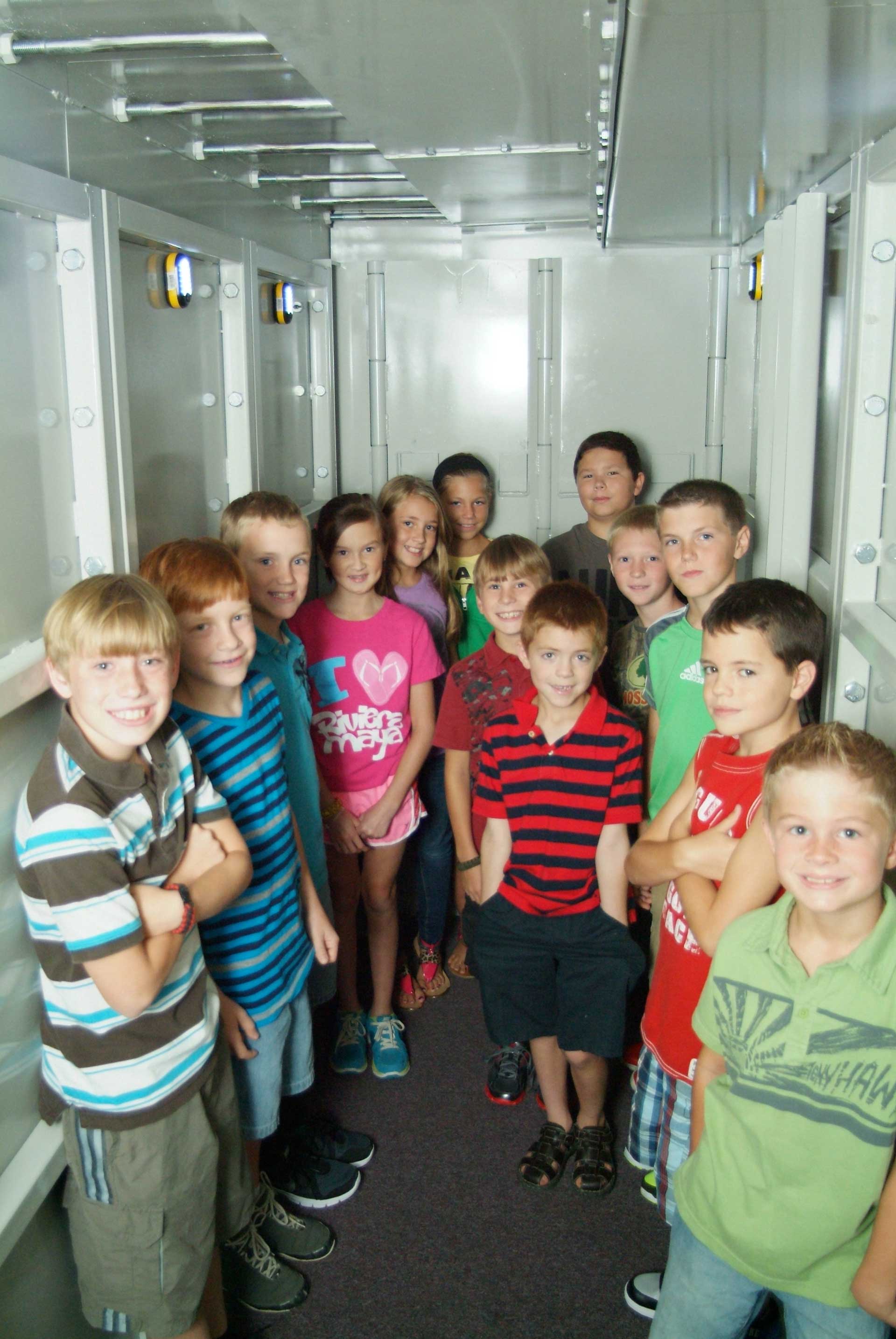
What School Safety Directors Should Know Before Choosing Bulletproof Mini-Shelters
School safety is no longer simply about policy. It is also about design that performs under pressure. As administrators plan for safer classrooms, two approaches are dominating the conversation: stationary mini-shelters permanently built into the classroom and deployable fold-out mini-shelters that slide out or unfold from the wall during emergencies.
At first glance, the deployable option seems attractive. It compresses into itself when not in use and creates the perception of saving space. It appears to offer flexibility, yet safety decisions can’t be made on appearances alone—they must be based on readiness, reliability, and human behavior under stress.
A stationary mini-shelter, permanently anchored into the floor, offers the one thing that fold-out systems can’t. And that is protection that’s always ready. There’s no setup, no mechanical dependency, and no instruction manual required. Teachers and students simply step inside and shut the door, and the shelter does the rest. In an emergency scenario where safety is measured in seconds, simplicity isn’t a convenience; it’s a lifesaving necessity.
The Space Myth and the Reality of Deployment
One of the most common misconceptions about deployable shelters is the idea that they “save space.” On paper, it sounds logical—they fold flat against the wall when not in use. But in reality, deployable shelters are rarely flat against the wall. They often still protrude from the wall in some fashion. Additionally, in practice, those few saved feet along the wall come with a permanent operational restriction: the space in front of the shelter must remain completely clear at all times.
Desks, bookshelves, or other furniture cannot occupy the deployment zone, or else the mechanism won’t function. This effectively makes that floor area unusable, erasing any supposed space advantage. By comparison, a stationary shelter sits flush against the same way that a bookshelf or storage cabinet would.
The greater challenge, however, lies not in the layout but in how the deployable shelters actually deploy. Fold-out units can operate either manually or electronically. Each comes with serious operational considerations and implications.
Manual deployment demands time, physical effort, and familiarity with the mechanism. Which can include hinges, pull handles, or sliding tracks. In reality, emergencies are chaotic environments where a substitute teacher, an untrained staff member, or a young student might be present. Expecting them to execute multiple steps under extreme stress is risky. Not to mention, you cannot guarantee that every person, even trained staff, will have the strength or dexterity needed to operate a manual deployable system at any given moment.
It may seem that an electronic deployment system could solve that issue. Just about anyone can push a button, right? But electronic systems also create new vulnerabilities. Power failures during severe weather can disable the motorized function entirely. Even under ideal conditions, moving parts require regular maintenance, including lubrication, track alignment, and electronic testing to ensure they do not jam or short out. Any failure in the mechanism during a real event could render the shelter unusable when it’s needed most.
These scenarios carry serious consequences: a teacher struggling to pull out a heavy door, a jammed track during a tornado drill, or an electronic circuit tripped by a power outage or surge could all compromise the deployable mini-shelter’s effectiveness. Worse, in an intruder situation, a fold-out shelter could theoretically be closed by the intruder, crushing the people inside it.
Simple, Intuitive, and Always Operational
Stationary shelters avoid all of those risks by design. With no folding walls, tracks, or power dependencies, they eliminate potential points of failure. Operation is as simple as closing and securing a door—something any adult or child capable of locking a door can do. That immediate, universal usability makes them inherently more reliable, regardless of strength or training.
From a maintenance perspective, stationary shelters also represent a lower total cost of ownership. There are no motors to replace, no hinges to realign, and no deployment tests to schedule. They’re built to last decades. Meanwhile, their fixed ballistic walls and anchored foundation provide consistent, verifiable protection while meeting both ballistic and EF5 tornado standards.
Beyond safety, permanent installations integrate more naturally into the learning environment. Their steel walls are magnetic, doubling as display or instructional space. They typically occupy less than 5% of the classroom, similar to a row of cubbies or bookshelves at the back of the room. Some models stop below the ceiling, allowing for storage above, making them part of the classroom’s daily function rather than an intrusion.
When sirens sound or a lockdown order is issued, there’s no time for troubleshooting. School safety directors must ask: Do we want a system that works only if deployed correctly, or one that’s ready the moment a door closes? The stationary classroom min-shelter provides the surest, most intuitive protection available, and it is always ready, always stable, always safe.
If you are ready to take the next step to protect your student body, connect with us, and we will get started on your free quote today.